An independent gemology reference for gemstone identification, treatments, inclusions, minerals, and field guides for students, collectors, and gem professionals.
A coral skeleton records growth, but living tissue supplies the energy that makes growth possible. Corals are animals, yet many reef corals obtain energy through a partnership with photosynthetic microorganisms. They can also feed on external resources. Understanding these energy pathways helps explain why changes in light, food and water conditions can affect coral growth and survival. [1] Two important energy pathways In photosymbiotic corals, algal partners capture light energy and share products of photosynthesis with the host. The animal also obtains food through heterotrophy, including the capture or uptake of organic resources. Their relative contributions differ among species and environments. [1] Symbiosis illustration, Figure 1 from the bleaching overview; used here to explain the nutritional partnership. Image: Norma Olguín-López and colleagues (2017) , IntechOpen source , CC BY 3.0 . Reproduced without scientific alteration. What does trophic plasticity mean? Trophic plasti...
Get link
Facebook
X
Pinterest
Email
Other Apps
Gemstone Treatments: Types, Detection Methods and Examples
Get link
Facebook
X
Pinterest
Email
Other Apps
-
Gemstone treatments and how gemologists detect them
Gemstone treatments change colour, clarity or other properties beyond ordinary cutting and polishing. This illustrated guide explains coating, dyeing, oiling, fracture filling, laser drilling, heating, diffusion and irradiation. The photographs show examples used in practical gemological examination.
Identification note: A photograph or a single visual clue rarely establishes treatment status. Some treatments require spectroscopy or chemical analysis, and some cannot be detected conclusively with routine tests.
Illustrated treatment types and detection features
Finding treatments that may have been made to enhance the color or appearance of the gemstones under examination is one of the gemologist's main duties. We must first understand what a treated gem is in order to understand enhancement or treatment. Thus, the treated gem may be
described as follows
Treated Gem: Any Gem material (Natural) which has been altered by a human, beyond ordinary cutting and polishing: For example, Heat-treatment corundum, oiled emerald, stabilized turquoise, etc
The term "enhancement" is defined to be any treatment process other than cutting and polishing
that improves the appearance (color/clarity/phenomena), durability, or availability of a gemstone
Purpose of Enhancement or Treatment
a. To improve Color and Clarity
b. To enhance Durability
c. To improve optical effects
D, Availbility / Accessablity
Tanzanite in
shades of violet and blue depends on heat treatment to produce enough supply to
meet the demands of the public.
Pink topaz is
another example of a gem that would (not)be available without heat treatment.
Not only are these treatments acceptable, they are necessary to keep these
products affordable and available.
Nature Citrine the yellow variety of Quartz is rare in nature. Most citrine is prodoced by heating of amethyst which is frequently available in nature.
Gemstone Treatments and Pricing
There are some gemstones that would not even exist if it were not for treatments. The abundance of citrine , in shades of yellow, gold and orange is the result of heat-treating amethyst. Naturally occurring citrine is quite rare in nature. If it was not for treatments the stone would be far more expensive than it is! Tanzanite in shades of violet and blue depends on heat treatment to produce enough supply to meet the demands of the public.
Pink Topaz is another example of a gem that would not be available without heat treatment. Not only are these treatments acceptable, but they are also necessary to keep these products affordable and available.
Recent demand for unheated sapphires and rubies has caused a price increase of as much as 50%-100% for unheated material. Does this mean that the untreated gem is more beautiful? NO! In most cases the heating enhances the gemstone to make it more beautiful; the price premium is the result of the rarity of being unheated!.
Types of Treatments and their Detection
1. Painting, Foiling or Coating
2. Dyeing
3. Impregnation and Filling using oiling, waxing, resin and polymer fillers
4. Laser treatment
5. Heat treatment
5.(a) Heat treatment without additives in corundum (ruby/sapphire)
5.(b) Heat treatment with additives For example glass filled, surface diffusion,
beryllium treatment etc) in corundum (ruby/sapphire)
6. Irradiation
1.Painting, Foiling or Coating:Adding a shiny backing, such a reflective metal piece is called foiling. The foil reflects light back out of the stone towards the observer. This makes the stone appear more brilliant. A transparent or translucent material is painted or foiled, usually only the back facets of the stones. Use of surface treatments such as films or thin surface layer applied to its entire surface to provide colour or other special effects.
NOTE: This type of treatment is not permanent and can chip or wear off. Do not use harsh solvents or chemicals on jewellery with this type of treatment.
Detection: Careful observation with 10x lens
paint layer on a quartz surface
paint layer on a quartz surface
Green painting on small colourless quartz crystal which shows the scene of tourmaline/Emerald embedded crystal in mother rock.
Green painting on small colourless quartz crystal which shows the scene of tourmaline/Emerald embedded crystal in mother rock.
Foiling or backing on Red Glass
Foiling or backing on Red Glass
Foiling or backing on Red Glass
Closed view of Coated Topaz
coated pink topaz in polariscoe
coated pink topaz in polariscoe
2. Dyeing: The introduction of colouring matter into a gemstone to give it a new colour, intensify present colour or improve colour uniformity. For example Agate, carnelian, chalcedony, coral, ivory, jade, opal, pearl, quartz, turquoise etc.
Detection: Magnification (concentrations of dye visible in veins and cracks), Spectroscope (Broad absorption bands due to chromium slats used as a dye), Most organic dyes will stain a swab moistened with acetone.
Aquamarine is dyed to resemble Emerald
concentrations of dye visible in veins and cracks
Dyed Quartz (noted the color concentration in cracks)
Dyed Quartz (noted the color concentration in cracks)
The low grade Sillimanite are dyed in different colors. Due to fibrious like inclusions it is favourite material for dyeing.
Sillimanite are colored in Red, blue and green which is best imitaion of ruby,
sapphire and Emerald respectivily. India is the main expoter of dyed sillmanite.
Dyed sillimanite .
Dyed Quartz beads String
dyed quatz in polarisocpe
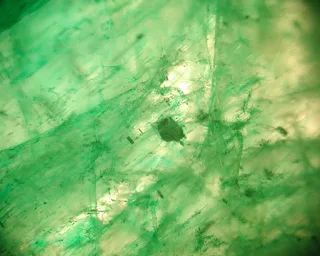
3. Impregnation and Filling using oiling, waxing, resin and polymer fillers: Certain gemstones such as Emerald, opal, turquoise, and agates are permeable (will allow fluids to penetrate and flow through them). These stones can accept dyes, oils and waxes. The filling of the small openings in the stone may allow a new colour to be added or allow a wax into the pores that will then make the stone have a glossy finish or fill cracks.Usually, a regular oil such as olive oil, peanut oil, coconut oil etc is used, but resins (both natural and plastics) have been reported. Almost all emeralds sold are oiled. Since it is standard practice, very little is said about its application and most consumers are unaware.
Detection: Magnification (Darkfield illumination+ fiber optic light. The dried-up filler in emerald's cavities displays white dots that have a unique appearance. Other test includes immersion microscopy. A suitable liquid would be bromoform whose refractive index of 1.56 is very close to that of emerald, which is around 1.57. Once an emerald is observed in bromoform, all that will be visible are those areas that contain lower refractive index filler.
Oil in Emerald (Oiled filled Emerald
Oil in Emerald (Oiled filled Emerald)
Cedar oil, oil with green color, opticon used in emerald treatment
Machine used for emerlad oiling
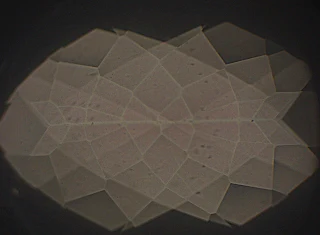
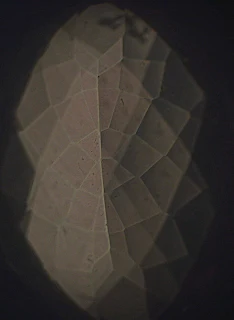
4. Laser treatment: Diamond are often laser drilled to reduce the visual impact of dark inclusion. A laser beam is used to drill a very fine hole, with a diameter of less than 0.02mm, through the diamond to reach the inclusion. The inclusion may be burnt out by a laser beam or removed with acid. The hole may then be filled with a glass or an epoxy resin filling to prevent the entry of dirt.
Detection: Many lasered diamonds are drilled through the crown. These may be seen with a 10x lens by careful inspection through the side of the stone.
Laser drilled diamond
Laser treatment in Diamond
5. Heat treatment :
Heating is the most common treatment available. It can cause the colour of a stone to lighten, darken, or change completely. It can bring about an improvement in clarity and brightness.
It is common for many heat treatments to be done on pre-formed stones, i.e. stones that have already been shaped or cut, and from which all unwanted material has been removed.
Heat treatment is very common in a wide variety of stones. For example:
1.Amber is heat-treated to darken the colour or to induce disc-like fractures known as sun-spangles.
Heat treatment in Amber
2.Brownish zoisite is heated to produce the colour of blue tanzanite
After heating brown color converted in blue
3.Greenish blue aquamarine is heated to produce blue aquamarine. A yellow colour component, caused by iron Fe3+(Ferric) ions, together with the blue colour caused by iron Fe2+, gives the greenish-blue colour of untreated aquamarine. By heating the material more of the blue causing ions are created as the yellow causing ions are reduced.
greenish blue aquamine is heated to remove secondary color
5. a Heat treatment without additivies in Corundum (ruby/sapphire)
Heat treatment is used extensively to alter the appearance of nearly all gem corundum.
Depending on the required effect, heating is carried out in either oxidizing or reducing (non-
oxidizing) atmospheres. For example, the blue sapphire with an excess of Fe2+ (Ferrous iron)
has a very dark colour. By heating these stones in an oxidizing atmosphere, i.e. in the
presence of oxygen, the Fe2+ changes to Fe3+ and the colour becomes paler.
Detection: Detection of heat treatment is possible because processes used to enhanced colour
and remove silk involve very high temperatures. Such heating modifies the appearance of the
internal and external features of corundum.
Surface features: pitting and pockmark may remain on the facets and girdle; however, most
corundum is treated in the rough state.
Crystal inclusion may appear pale, with rounded outlines; original crystal form is lost. Disc-like
stress fractures develop around inclusions.
Natural Sapphire before and after heating
Natural Ruby before and after heating
Sri lanka sapphire before and after heating
discoid like inclusions in heated sapphire
discoid in heated sapphire
HPHT Treatment in Sapphire
5(b). Heat treatment with additives in Corundum (ruby/sapphire)
·Glass (Lead) filling
External: Open cavities (usually on pavilion), filled with glass for a
better looking stone (seals cavities, adds weight). Internal: Traces of glassy residue in fractures after heating may be
found as a by-product of the particular heating process used. (Stable).
ruby before and after heat treatment with addatives (lead glass etc)
Glass filled ruby / sapphire after cutting & polishing
Detection: Magnification.
Differences in luster between glass infilling and stone plus possible bubbles in filling and blue orange
flashes.
Air bubbles in glass filled ruby
Lead glass ruby under gemological microscope Surface Diffusion:
Corundum is also surface diffused to improve its colour. In this process, colour and asterism can be induced in the outer part of a ruby or sapphire. Surface diffusion is achieved by coating the stones with aluminium oxide and the appropriate compounds and subjects the stones to very high temperature for several days. The blue colour is produced by the diffusion of iron and titanium, red by chromium, yellow by nickel. Asterism requires the introduction of excess titanium. The depth of diffusion penetration is small--- a fraction of a millimetre because the process is limited and works extremely slowly, even at the very high temperatures that are required.
Detection: Immerse stone (Ideally in di-iodomethane / methlene iodide). Colour is concentrated in a thin surface layer.
Surface Diffused Sapphire
Surface Diffused Sapphire
Surface diffused sapphire.
Beryllium treatment or Bulk Diffusion:
A recent process involving the heat treatment of corundum in the presence of beryllium has been developed. This causes diffusion of colour through most, all of the stone.
Beryllium treated sapphire before and after treatment
Detection: Melted crystals, cottony appearance, Color concentration around a guest crystal.
Blue Dot in beryllium treated Corundum
Blue Dot in beryllium treated Corundum
Blue Dot in beryllium treated Corundum
smoke type inclusions are also noticed in new type beryllium treated sapphire
6.Irradiation( Coloration by Irradiation):
Irradiation by atomic particles and rays from radioactive substances can be used to alter the colour of gemstones.
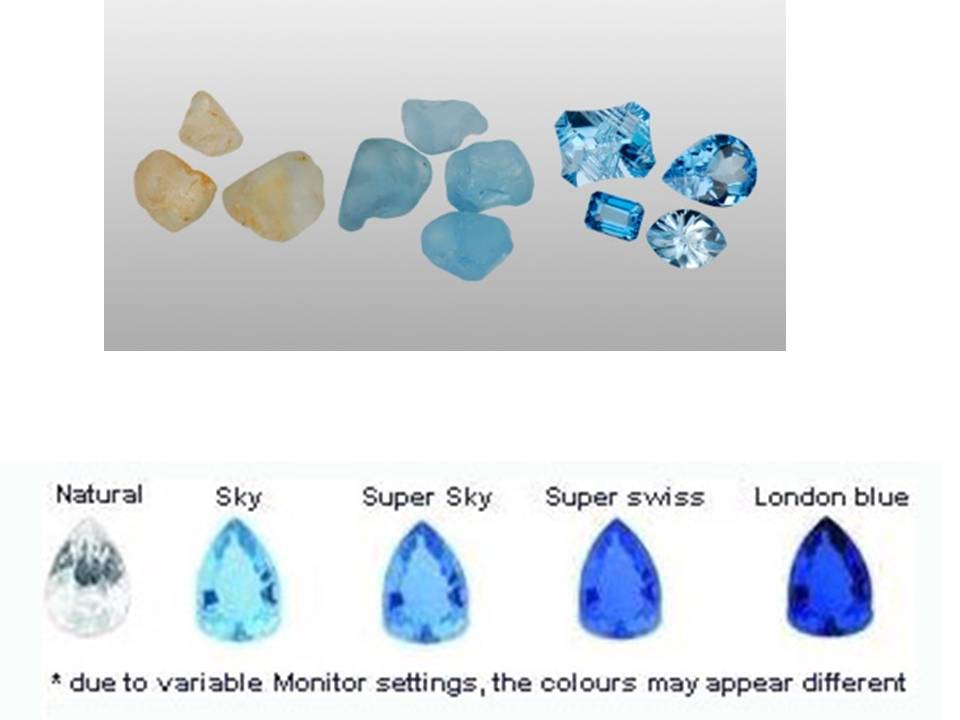
The blue colour often seen in treated topaz is also caused by irradiation, but heat treatment is also required.
The Major changes on irritating gemstones
colorless topaz is converted in blue color after irradation treatment.
Mostly Diamond color is enhanced by irradiation treatment
irradiated Blue diamond
Detection: Unusual colour
Important limits of treatment detection
Unusual colour alone does not prove irradiation. An acetone test that removes no colour does not exclude dyeing; solvents can also damage dyes, coatings and fillers. Microscopic features can suggest heating or diffusion, but beryllium diffusion may require specialist chemical testing.
Treatment disclosure and gemstone care
Ask for a clear description of any detected treatment and suitable care instructions. Filling and coating can affect how a gem tolerates cleaning or repair. Treatment status should be considered alongside identity, quality and condition when discussing value.
💎 Gemology Quiz 1. What does gemology study? The study of rocks only The study of gemstones and their properties The study of fossils 2. Who is a gemologist? A person who mines gemstones A person who designs jewelry A person who identifies gemstones using instruments 3. Which of the following is NOT a characteristic of a mineral? Naturally occurring Organic in nature Has a defined chemical composition 4. What makes a gemstone valuable? Only its size Beauty, rarity, and durability Color only 5. Which of the following is an organic gem? Sapphire Pearl Emerald 6. The Mohs scale measures what property? Toughness Hardness Transparency Submit Quiz Further reading introduction to gemology Gemology MCQs Part-1
Gemology MCQs Gemology Multiple-Choice Questions 21. Separating natural pink sapphire from synthetic pink sapphire commonly relies upon a microscopic study. True False 22. In a round brilliant cut, the total number of facets is: 57 59 60 None of the above 23. A spectroscope is used to detect the spectrum. True False 24. Refraction is the bending of light. True False ...
Gemstone MCQs Quiz Test Your Knowledge in Gemology Part 6 1. A 2-carat fine-quality ruby is worth more than 10 rubies of the same color and quality, which have a total weight of 4 carats . a) True b) False Correct Answer: a) True 2. One carat equals: a) 1 gram b) 1/10 of a gram c) 1/5 of a gram d) 1/2 of a gram Correct Answer: c) 1/5 of a gram 3. A ten-pointer is a stone that weighs: a) 10 carats b) 1/10 of a carat c) 10 facet junctions d) 10 grams Correct Answer: b) 1/10 of a carat 4. When comparing gem prices, you should compare their: a) Per-carat cost b) Overall size c) Density d) Facet count ...







Very great post.Thanks for sharing this post.
ReplyDeleteBest astrology consultant in Coimbatore
Best online astrologer in Coimbatore
Top Professional Astrologer In Coimbatore
Top Online Astrologer in Coimbatore
best astrology specialist in coimbatore The Best astrological consultant in Coimbatore can offer insightful advice on your life's direction and the future. Whether you have concerns about your relationships, work, or personal development, our top astrology expert in Coimbatore is here to provide insight and advice.